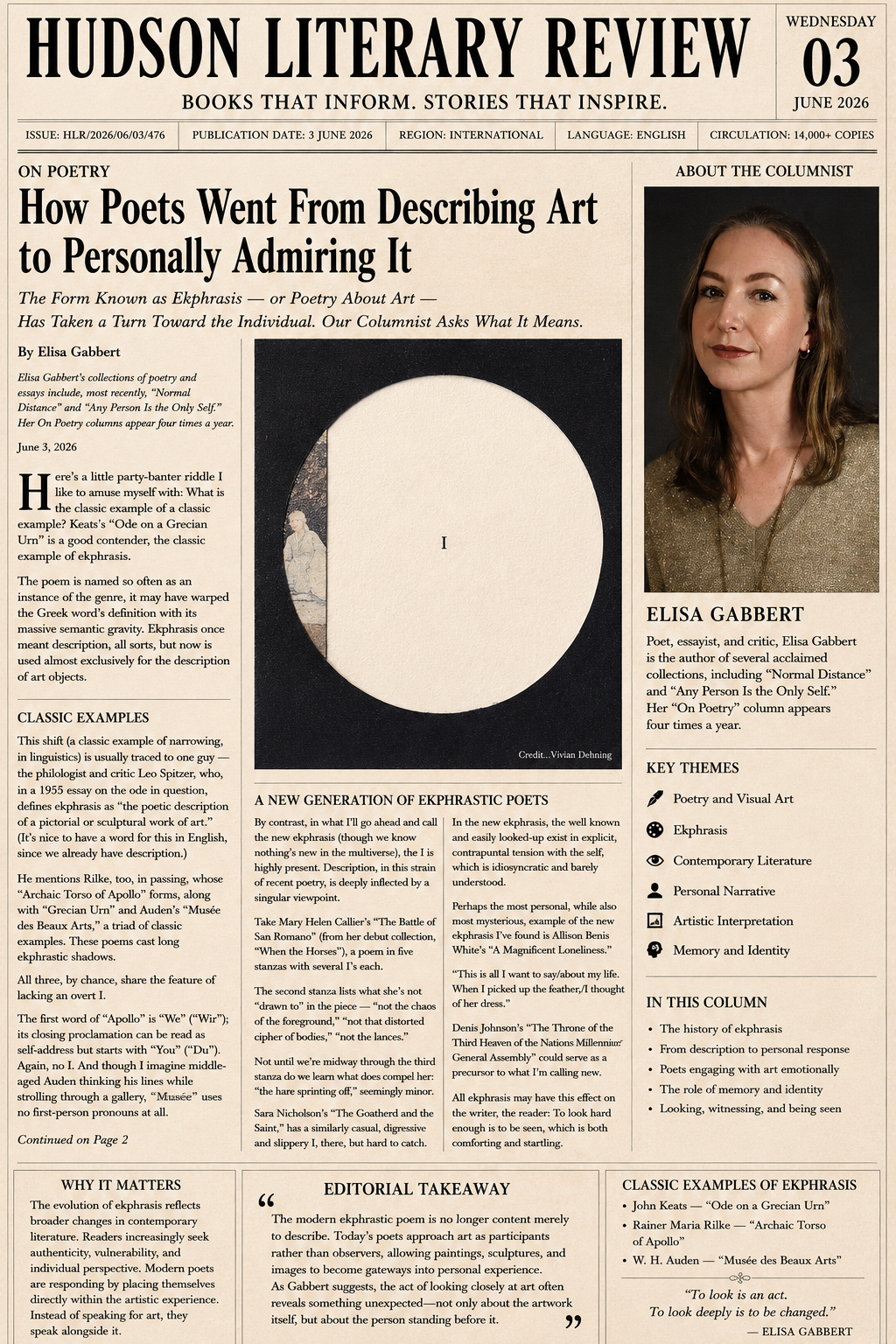
There is a moment, early in How Poets Went From Describing Art to Personally Admiring It, when the reader senses that something larger than story is at stake.
Elisa Gabbert explores the evolution of ekphrasis and how contemporary poets have transformed the relationship between art and personal expression.
Plot, in the conventional sense, is almost beside the point. What propels the pages is closer to attention — the writer's, then ours — turning over the ordinary until it gives up its odd, persistent light.
What the Book Knows
Plot, in the conventional sense, is almost beside the point. What propels the pages is closer to attention — the writer's, then ours — turning over the ordinary until it gives up its odd, persistent light.
“There is no false note here, only a writer working at the full reach of her instrument.”
Plot, in the conventional sense, is almost beside the point. What propels the pages is closer to attention — the writer's, then ours — turning over the ordinary until it gives up its odd, persistent light.
The prose moves like weather. Sentences gather, break, gather again. What looks at first like restraint is, on closer reading, a kind of generosity — the writer trusting the reader to feel the storm without being shown the lightning.
The Weight of the Quotidian
There are passages in this book that ask to be read twice, not because they are difficult, but because the first reading is too occupied with surprise to register the music underneath.
How Poets Went From Describing Art to Personally Admiring It is the kind of book that ends and then keeps ending — in conversations the next morning, in margins revisited a week later, in sentences that surface, unbidden, on long walks.